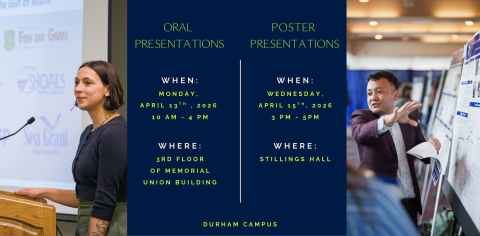
The Graduate Research Conference (GRC) is an annual, two-day showcase where UNH graduate students from all disciplines present their research in oral and poster sessions. Designed to foster community, scholarly exchange, and professional growth, the GRC provides a platform to share your contributions with peers, faculty, and the broader UNH community. View our conference programs below:
This year, we are introducing a theme-based approach for both oral and poster presentations that encourages students to connect their work to one of four broad categories: Strengthening UNH’s Impact, Interdisciplinary Research, Commitment to Well-Being & Belonging, and Teaching Excellence & Scholarship.
Learn more about each research category below.
Explore research that highlights UNH’s role in sustainability and environmental stewardship, from lessons learned in protecting natural systems to strengthening the connections between policy, technology, and communication in addressing today’s environmental challenges.
Engage with work that bridges disciplines and reimagines learning, emphasizing the impact of support systems and the value of analyzing complex issues through modern, integrative perspectives.
Discover research that centers community, creativity, and care, celebrating the role of the arts and human expression in fostering connection, resilience, and a sense of belonging.
This session will run in a similar fashion to how the GRC presentations have run in the past. You will be organized into department-relevant groups, no matter what your research topic is. You do not need to connect to any of the UNH strategic plan themes if you register for this option.
Registration for the GRC will reopen in Spring 2027.
Students are encouraged to explore the following award opportunities available to conference participants.
GRC Awards & Prizes
To encourage students to showcase work across all themes and to recognize student engagement with the new GRC approach, the Graduate School will provide small monetary prizes (distributed at random) to students who present their work at the GRC. Prizes will be divided equally across the two presentation categories:
- 16 recipients who present Poster Presentations
- 16 recipients who present Oral Presentations (4 per each theme described above)
Prizes will be applied directly to the recipient’s student account.
The UNH Sustainability Institute is sponsoring research awards that contribute to a more sustainable future. The awards will recognize research that spans a diverse set of disciplines and topics, contributing to one (or more) of the United Nations 17 Sustainable Development Goals. Two $500 awards are available; one for a poster and one for an oral presentation. Please watch this video to learn more about integrating sustainability into research.
Poster and Oral presentations should include visual and verbal articulation of which UN Sustainable Development Goal(s) are being addressed in the research, as well as how this research could positively impact sustainability knowledge and/or practice.
To be considered for the Sustainability Award, please rank “Option 1A: Strengthening UNH’s Impact Through Sustainability” as your top choice on the registration page.
The UNH Joan and James Leitzel Center for Mathematics, Science, and Engineering Education offers annual awards at the UNH Graduate Research Conference (GRC) to recognize exemplary STEM education and outreach projects presented at the GRC. The Leitzel Center may grant up to two awards each year.
Award selection is based on the presenter’s demonstration of a significant contribution in at least one of two key areas:
- Graduate student contributions made in the design and implementation of STEM education research projects, which advance our understanding of STEM education.
- Graduate student contributions made in the design and implementation of STEM education outreach projects, which directly impact STEM teachers, instructors and faculty or STEM students of all ages through the application of enhanced STEM content or pedagogies.
Each award is valued at $500. To be considered, presenters must contact Steve Hale at steve.hale@unh.edu to discuss their project and eligibility.
